Pulp Paper Products Manufacturing FAQs
Considering the benefits pulp paper packaging in your product’s lifecycle? Here’s a list of questions we are most often asked - and the answers to help guide you.


Step 1 - Post-Industrial Waste Paper
The process begins by collecting waste paper products such as newspapers, magazines, boxes or other items originally destined for the landfill.

Step 2 - Slurry
Waste paper products are mixed with water and pulped into a slurry. This mixture is what is used to form the final product.
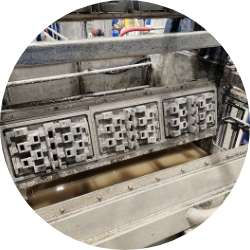
Step 3 - Forming
During the forming step, the pulp slurry is vacuum formed into a three-dimensional shape and the water is reused for the next batch of product.

Step 4 - Oven Drying
The formed product is then transferred to a conveyor and dried in an oven. Heat is reclaimed to preheat process water.

Step 5 - Afterpressing
A secondary process can be added where the product is pressed with high heat and pressure to improve smoothness and dimensional stability.
Molded pulp packaging and cardboard/corrugated packaging are both fiber-based materials, but they are fundamentally different in structure and function. Cardboard and corrugated packaging are made from flat, layered sheets of paper that are cut, folded, and assembled into boxes or cartons — they excel at providing outer structural strength, stacking support, and compression resistance during shipping.
Molded pulp, by contrast, is formed by shaping a wet fiber slurry directly in a mold, then drying it under vacuum and pressure into a precise three-dimensional shape. This process allows molded pulp to be custom-engineered with exact cavities, contours, and structural supports that cradle a specific product — something flat cardboard simply cannot replicate. As Pulp Moulded Products describes it, their packaging delivers "shock protection on par with Styrofoam plus molded plastic stackable efficiency," combining the best of both worlds in a single eco-friendly solution.
At Pulp Moulded Products, the primary input is recycled fiber sourced through a diverse procurement network — including integration with clients' own supply chains and other recycled fiber streams. PMP processes 5,000 metric tons of fiber per year at its Ontario facility and 3,000 metric tons per year at its Nevada facility, recycling over 18 million pounds of fiber annually into finished packaging. This diverse fiber procurement strategy is a deliberate design choice: it creates a resilient supply chain, maintains high standards for consistency and performance, and reduces dependence on any single raw material source.
Molded pulp packaging has one of the strongest sustainability profiles of any packaging material available today. The fiber inputs are post-consumer recycled paper and cardboard that would otherwise be landfilled or incinerated. Using recycled fiber directly reduces demand for virgin timber, lowers energy consumption in production, and keeps materials circulating in the economy rather than ending up as waste.
PMP's fiber procurement model is designed to be both resilient and responsible: by sourcing from multiple streams — including our clients' own supply chains — reducing supply chain risk while maintaining high standards for fiber quality and consistency. We are also a member of the IMFA (International Molded Fiber Association) and holds biomaterial certification, further underscoring our commitment to verified sustainable practices.
The preferred disposal method for molded pulp packaging is recycling through standard paper and cardboard streams — no special sorting or drop-off is required. Consumers can place clean molded pulp inserts, trays, and shippers directly into their curbside paper recycling bin in most municipalities. This is one of molded pulp's key advantages over plastic foam (EPS), which is rarely accepted in curbside programs and frequently ends up in landfills. For food-service applications where the packaging may be soiled, composting — either in an industrial composting facility or a home compost bin — is the next best option, as the fiber will break down naturally without leaving toxic residues.
Even in cases where neither recycling nor composting is available, molded pulp's biodegradability means it will decompose far faster than plastic or foam alternatives, with no lasting environmental harm. Brands and businesses using molded pulp packaging are encouraged to include clear disposal instructions on or with their packaging to maximize consumer participation in proper end-of-life handling. PMP's commitment to a closed-loop, zero-waste process means the company designs its packaging with end-of-life in mind from the start — ensuring that the fiber that begins as recycled material can return to the recycling stream and be used again.
Molded pulp packaging is far more customizable than most buyers initially expect. Because the material is shaped in a mold rather than cut and folded, it can be engineered into virtually any three-dimensional form, from simple trays and inserts to complex multi-cavity designs with integrated ribs, channels, finger-pull features, snap-fit closures, and ventilation holes. Shape, size, wall thickness, and internal cavity layout can all be tailored precisely to the product being packaged, eliminating movement during transit and reducing the need for additional cushioning materials. Surface finish can range from a natural, textured fiber appearance to a smooth, Type 4 refined look suitable for premium consumer goods. Color can be incorporated during fiber preparation for even, long-lasting results that match brand palettes.
Pulp Moulded Products offers free custom packaging design as part of its service offering — a significant differentiator in the industry. PMP's team works with clients from concept through rapid prototyping and into full production, supporting both startups and high-volume orders. PMP covers all four types of molded pulp products (Type 1 through Type 4), giving clients access to the full spectrum of surface finishes and structural capabilities — from rough-formed industrial packaging to precision thermoformed premium inserts.
Yes — molded pulp packaging supports several effective branding and logo integration techniques, though the approach differs from traditional printed cardboard. The most premium and durable method is in-mold embossing or debossing, where logos, brand marks, text, or surface textures are engineered directly into the mold itself. This means the branding is literally formed into the packaging during production — requiring no ink, no coatings, and no additional assembly steps. The result is a tactile, permanent brand impression that feels premium and aligns perfectly with sustainability messaging.
For more complex or multi-color branding needs, paper sleeves, belly bands, or FSC-certified labels with compostable adhesives can be applied to the outside of the molded pulp component, allowing full-color graphics while keeping the overall package biodegradable.
Custom molded pulp packaging is best suited for medium to high production volumes, primarily because of the tooling investment required upfront. Industry-standard minimum order quantities (MOQs) generally range from 5,000 to 50,000 units. Below these thresholds, the tooling cost per unit becomes disproportionately high, making corrugated or die-cut alternatives more cost-effective for small or trial runs. Ask us about our standard packaging sizes which can decrease MOQs and save on tooling costs. Pulp Moulded Products offers a lower volume options for our standard wine, beer, and candle packaging.
Moisture is the primary performance limitation of standard molded pulp packaging. Because molded pulp is made from cellulose fibers — which are naturally hydrophilic (water-attracting) — uncoated packaging will absorb moisture from the environment, which progressively weakens its structural integrity. This means that standard molded pulp inserts exposed to high humidity, condensation, or direct liquid contact can soften, deform, or lose their cushioning effectiveness over time. The degree of vulnerability depends on the fiber type and manufacturing process: wet-pressed molded pulp is denser and smoother, offering better natural moisture resistance than dry-pressed products, but neither is inherently waterproof without additional treatment.


